April 24, 2026
Most students have the idea that in order to get better results one must be able to spend longer periods of time sitting at their desk. Here is the reality of how the brain works: the brain does not function like a hard drive in which the more input it receives the more output it produces. The structure and organization of how you review and study your subject materials is by far a greater factor than how many hours you put into studying.
Smart Notes have been created by Tom T. Joseph of TOMS College of Engineering with this principle in mind, as a way to organize your notes in an easy way to read, they were also built as a learning system that aligns to the way your brain encodes, retains and retrieves knowledge. The science supports all of this.
We will explore the key cognitive principles that contribute to the effectiveness of Smart Notes.
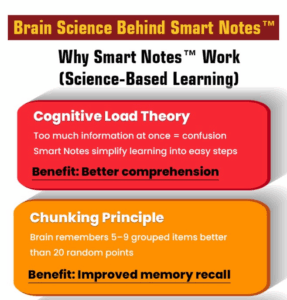
Cognitive Load Theory: Keep Working Memory Clear
Working memory is the area of your brain responsible for ongoing information processing. It has a very small amount of space – similar to a whiteboard. When we read complicated, cluttered paragraphs, it rapidly fills the whiteboard up and does not allow us any room to adequately comprehend or process what we have just read. This is known as cognitive overload and occurs frequently. Furthermore, cognitive overload is also one of the largest "hidden" contributors to students not performing as well as they could – even if they study intensely.
Structured notes reduce what researchers call “extraneous cognitive load” – the mental effort wasted on navigating messy, unorganised content.
How Smart Notes™ Help
- Break content into small, digestible units rather than long blocks of text
- Arrange ideas in logical steps so the brain follows a clear path
- Use clear headings that act as signposts, reducing the effort of orientation
- Maintain a sequential flow so the reader never feels lost
Effect: Lower cognitive overload → better comprehension → quicker understanding in less time.
Chunking Principle: Group to Remember More
Psychologist George Miller’s landmark research showed that the human brain can hold roughly 7 (plus or minus 2) pieces of information in short-term memory at a time. If you have 20 scattered points to remember, you’re well beyond that limit. But if you organise those 20 points into 5 meaningful groups, your brain treats each group as a single unit – and suddenly the load becomes manageable.
This is the chunking principle, and smart notes apply it naturally.
| Approach |
Points to Remember |
Memory Load |
| Unstructured notes |
~20 scattered points |
Very high – likely to forget |
| Smart Notes™ |
5 organised groups |
Manageable – stable retention |
Effect: More stable short-term memory storage and significantly better long-term retention over revision cycles.
Dual Coding: Words + Visual Structure
Dual coding theory, proposed by Allan Paivio, tells us that the brain encodes information through two separate channels – verbal and visual. When both channels are activated at the same time, memory strength increases dramatically. You’re essentially creating two pathways to the same piece of information.
Smart notes naturally activate both channels through:
- Headings and sub-headings that create visual hierarchy
- Numbered lists that give the eye a clear sequence to follow
- Diagrams that translate abstract concepts into spatial images
- Formula boxes and highlighted keywords that stand apart visually
The result? Students who use structured notes don’t just know the answer – they can recall it faster because they’re pulling from two memory stores instead of one. That speed advantage is real in an exam hall where every minute counts.
Active Recall: Practise Pulling Answers From Memory
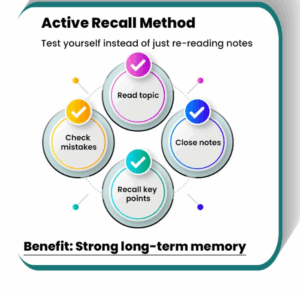
Re-reading your notes feels productive, but research consistently shows it’s one of the least effective revision strategies. The brain doesn’t strengthen a memory simply by seeing information repeatedly. It strengthens memory by being forced to retrieve it.
This is the foundation of retrieval practice – and smart notes are perfectly designed for it.
Student-Friendly Routine
- Read one short Smart Notes™ block (a single topic or sub-topic)
- Close the notes completely
- Write down all the keywords, steps, or points you can recall from memory
- Re-open your notes and check what you got right and what you missed
- Patch the gaps and repeat
This takes less than 10 minutes per topic. But the impact on long-term retention is far superior to passive re-reading. Because smart notes are compact and well-organised, this retrieval routine is quick, focused, and easy to stick to.
Spaced Repetition: Time Reviews to Beat Forgetting
Hermann Ebbinghaus discovered the forgetting curve more than a century ago, and it’s still one of the most important insights in learning science. Without revisiting it, you’re likely to lose nearly 70% of newly learned information within just 24 hours. -But strategically timed reviews dramatically slow this decay and eventually move information into long-term memory.
A simple spacing plan that works well for students:
| Review Session |
When to Do It |
| First review |
Same day (within a few hours of learning) |
| Second review |
3 days after |
| Third review |
7 days after |
| Final review |
1–2 days before the exam |
Why smart notes make this possible: Their compressed, structured format means each spaced review takes only 10–20 minutes per topic instead of re-reading entire textbook chapters. That makes it realistic to actually follow a spacing plan, even with multiple subjects.
Schema Formation: Build a “Knowledge Architecture”
Cognitive psychologists describe schemas as organised mental frameworks that the brain uses to store and connect related knowledge. When new information fits into an existing schema, it’s understood and retained much faster. When it doesn’t fit anywhere, it floats loosely and is easily forgotten.
Smart notes build schemas deliberately by organising content in hierarchical, interconnected structures.
How This Looks in Notes
- Topic → Sub-topics → Definitions → Examples (a clear hierarchy your brain can map)
- Cross-links between related ideas, e.g., “Compare this with X” or “See also Y”
- Consistent structure across chapters so patterns become familiar over time
Over time, students who use smart notes don’t just memorise information – they develop a genuine architecture of understanding. New topics in the same subject slot in naturally because the framework already exists. This is also why smart notes work especially well for subjects studied across multiple semesters.
Exam Retrieval Advantage: Structure Guides Writing
All of the preceding content is combined into one experience in real testing conditions. When a student sits down to write a response, they are retrieving information and then determining how to structure, or sequence and present it, all under a limited time period.
Smart notes will completely eliminate the burden of structuring the answer. By mirroring an answer's natural structure (headings, sub-headings, sequences), the brain retrieves the information as it was stored. As a result, there will be no need for students to stop and consider what they should write next because the structured answer format will automatically carry the students through the writing process.
The practical outcome:
- Faster writing – no pause to organise mid-answer
- Clearer answers – logical, examiner-friendly presentation
- More scoring points covered – because structured recall is more complete than random recall
Emotional Confidence Effect: Lower Anxiety, Clearer Thinking
Exam anxiety is not just an emotional problem – it has a direct cognitive effect. Stress and anxiety consume working memory resources, leaving less mental capacity available for actual thinking and writing. A student who enters the exam hall anxious is effectively working with a smaller brain.
Well-organised, predictable notes reduce uncertainty. When students know their notes are structured, complete, and easy to recall, they feel prepared. That confidence:
- Reduces cortisol-driven anxiety responses before and during the exam
- Keeps working memory resources available for retrieval and writing
- Supports clearer focus and fewer mind-blanks under pressure
It’s not just about feeling better – it’s about having more of your cognitive capacity actually available when you need it most.
Smart Notes™ in One Line: Align With How the Brain Learns
Every element of the smart notes system maps to a well-established principle of cognitive science:
| Cognitive Principle |
What It Does |
Smart Notes™ Effect |
| Cognitive load reduction |
Frees up working memory |
Easier, faster processing |
| Chunking |
Groups information logically |
Higher immediate recall |
| Dual coding |
Engages verbal + visual memory |
Stronger, faster retrieval |
| Active recall |
Forces retrieval practice |
Superior long-term retention |
| Spaced repetition |
Reviews at optimal intervals |
Durable memory over weeks |
| Schema formation |
Builds knowledge architecture |
Deeper understanding, faster learning |
Together, these principles create a high-efficiency learning architecture. Students don’t just know more – they can access what they know faster, present it more clearly, and do it without extending their study hours.
Conclusion: The Science Says Structure Wins
Getting ahead by studying more is not always an option. Getting ahead through studying smarter (where you use the architecture of your brain to help) creates a large amount of progress.
The smart note system is a system of note-taking based on research in cognitive science, dating back decades. Each of the structural components (headings, order, keywords and visual layout) all have specific purposes; they help your brain to encode, store and access information better.
Students at TOMS College of Engineering who use smart notes achieve between 20-40% increases in exam scores because they learn to use study time to their advantage instead of just putting in extra hours studying.
Frequently Asked Questions (FAQs)
Q1. Do Smart Notes™ still help for theory-heavy subjects?
Yes – in fact, theory-heavy subjects benefit the most. Subjects loaded with definitions, classifications, and explanations are exactly where the chunking, schema-building, and structured recall principles of smart notes deliver the biggest advantage. When content is dense and complex, having a clear organisational framework makes it far more manageable to learn and retain.
Q2. I’m not good at drawing – do I need diagrams?
Not necessarily. Dual coding doesn’t require artistic ability. Even simple boxes, arrows, numbered lists, and visual hierarchy created through headings and indentation activate the visual channel. A rough sketch is often more effective than a perfect drawing anyway – the act of creating it is what strengthens the memory.
Q3. What’s a quick spacing plan I can follow?
A practical plan for most students: review your smart notes on the same day you study the topic, then again after 3 days, then after 7 days, and finally 1–2 days before the exam. Each pass should take only 15–25 minutes per topic because smart notes are already compressed and organised. Consistency matters more than perfection – even three spaced reviews dramatically outperform last-minute cramming.
Q4. Is testing myself really better than reading twice?
Absolutely. This is one of the most well-supported findings in learning research, often called the “testing effect.” Active retrieval – closing your notes and forcing yourself to recall information – strengthens memory far more than passive re-reading. A single retrieval attempt after reading is more effective for long-term retention than reading the same material two or three additional times.
Q5. Can structure actually reduce exam anxiety?
Yes, and the mechanism is cognitive, not just emotional. Anxiety competes with working memory for mental resources. When students feel genuinely prepared because their notes are organised, complete, and easy to navigate, anxiety decreases – and that directly frees up cognitive capacity during the exam. Students who know their material is structured and retrievable walk into the exam hall with a real mental advantage.
 APPLY NOW
 FEE STRUCTURE