Welcome to TOMS College of Engineering – Shaping the Future of Aeronautical Engineering
Launch Your Aviation Career with India’s Premier Live-Aircraft Training Engineering College
- Approved by the All India Council for Technical Education (AICTE), New Delhi
- Affiliated to APJ Abdul Kalam Technological University (KTU), Kerala
- Accredited by NAAC
Program Overview
The Bachelor of Technology (B.Tech) in Aeronautical Engineering at TOMS College of Engineering is a rigorous, 4-year undergraduate program designed for students who aspire to design, manufacture, test, and maintain flight-capable vehicles. Navigating within Earth’s atmosphere, this discipline bridges the gap between pure mechanical physics and cutting-edge aerospace systems.
At TOMS, we combine university-prescribed theoretical frameworks with unique practical infrastructure, ensuring our graduates enter the aviation sector as industry-ready engineering professionals.
- Course Duration: 4 Years (8 Semesters)
- Sanctioned Annual Intake: 60 Seats
- Eligibility Criteria: Candidates must have completed 10+2 with a minimum of 45% aggregate marks in Physics, Mathematics, and Chemistry/Computer Science/Biotechnology from a recognized board. Admissions are processed based on the 10+2 academic scores and a valid KEAM (Kerala Engineering Architecture Medical) entrance rank. Lateral entry options are available for eligible diploma holders.
Outcome-Based Education (OBE) Framework
Our curriculum aligns strictly with the standards set by the National Board of Accreditation (NBA), driving clear outcomes for student development.
Program Educational Objectives (PEOs)
- PEO 1: Core Technical Competence: To equip graduates with sound analytical and practical knowledge in aerodynamics, structural design, propulsion, and avionics to solve complex aeronautical problems.
- PEO 2: Professional Excellence & Innovation: To prepare students for successful technical roles in global airlines, maintenance organizations, defence sectors, and research laboratories, or for pursuing advanced post-graduate studies.
- PEO 3: Leadership and Ethics: To cultivate strong communication skills, project management capabilities, team spirit, and an understanding of environmental safety and ethical responsibilities in the aviation ecosystem.
Program Specific Outcomes (PSOs)
- PSO 1: Engineering Analysis & Synthesis: Apply advanced Computational Fluid Dynamics (CFD) and Finite Element Analysis (FEA) tools to design and evaluate aerodynamic bodies, structural components, and efficient airframes.
- PSO 2: Aircraft Operations & Diagnostics: Demonstrate hands-on capabilities to troubleshoot, service, and maintain real-world engine powerplants, mechanical linkages, control surfaces, and avionics instrumentation bays under regulatory compliance frameworks.
State-of-the-Art Infrastructure & On-Campus Live Hangar
Traditional textbooks cannot teach the physical realities of a jet engine or a fuselage assembly. TOMS College of Engineering stands out among top engineering institutions by providing students access to an on-campus, fully equipped training hangar featuring two operational live aircraft.
The TOMS Live Aircraft Fleet
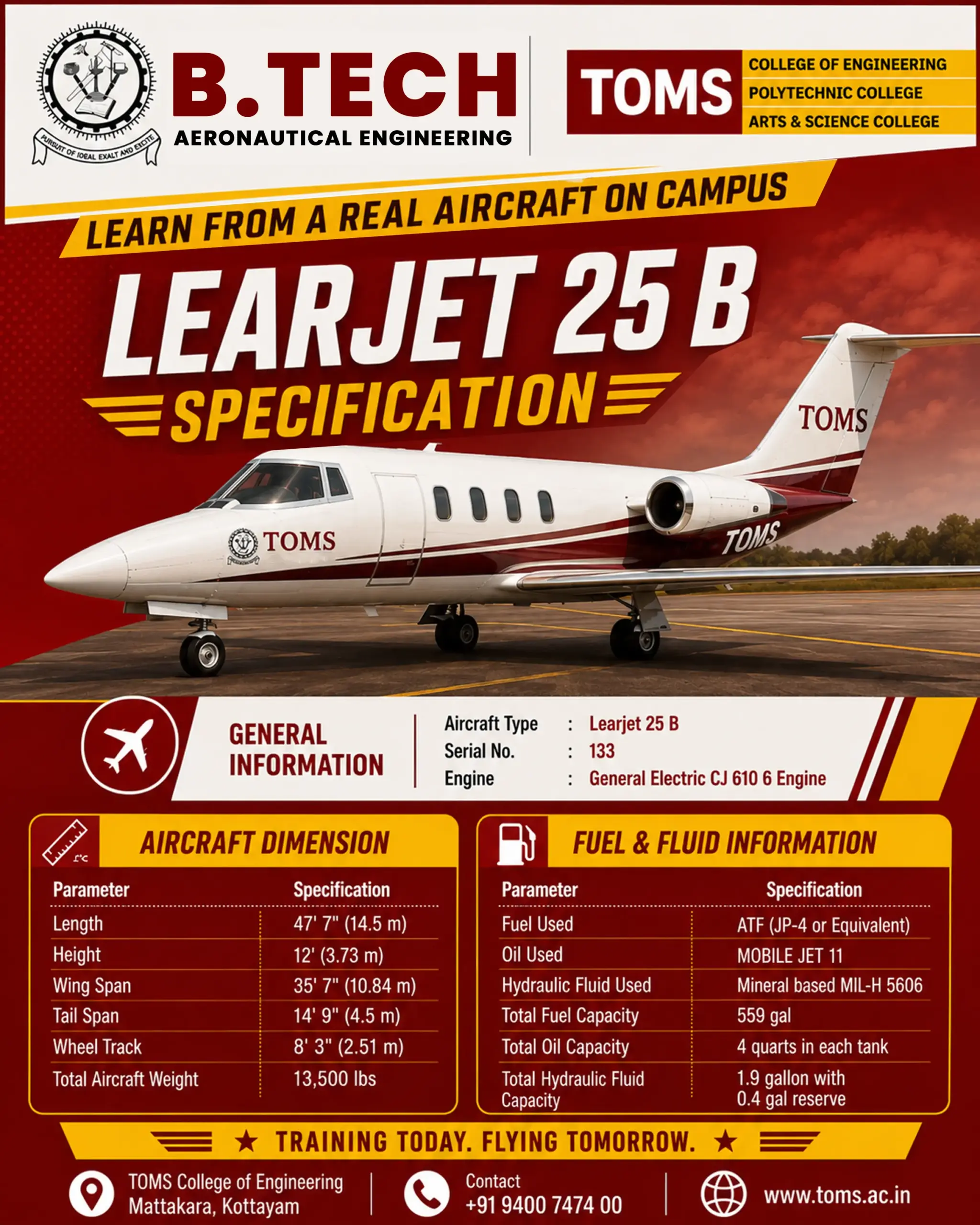
- Learjet 25B (Twin-Engine Business Jet): A fully intact, 10-seater heavy corporate jet used as an active learning lab. Students perform diagnostic training on heavy aircraft structures, commercial flight deck instrumentation configurations, hydraulic landing gears, pneumatic loops, cabin pressurization systems, and advanced avionics bays.
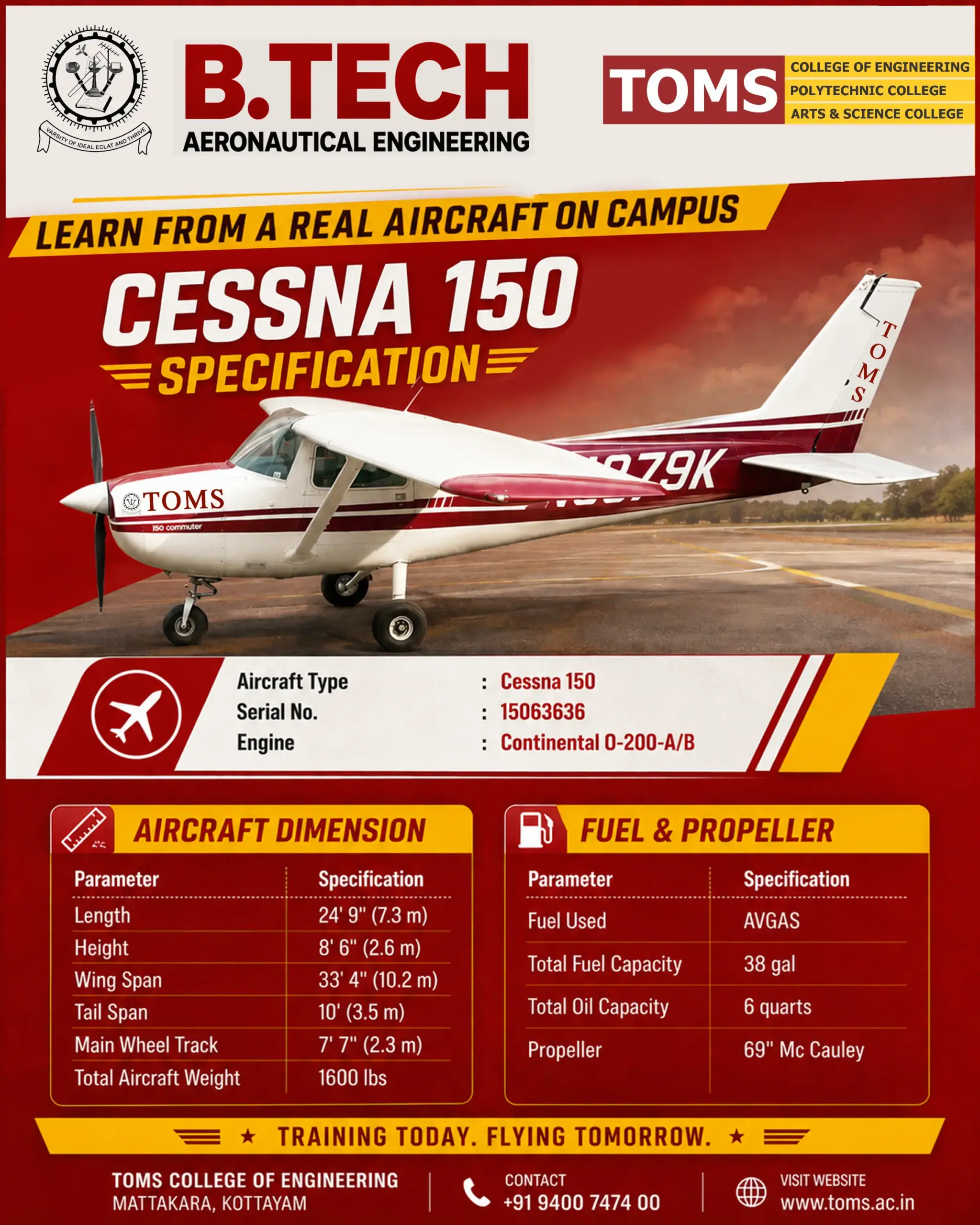
- Cessna 150 (Light Aircraft): A globally renowned two-seater trainers’ model utilized to visually demonstrate structural rigging, flight control surface linkages (ailerons, elevators, rudders), weight and balance calculations, and primary aerodynamic geometry.
Advanced Aeronautical Laboratories
1. Propulsion & Aero-Engine Lab
This dedicated laboratory focuses on the thermodynamics and mechanics of aircraft propulsion systems. Students receive hands-on training with an array of actual powerplants:
- Boeing Series Engines: Structural breakdown and design studies of high-bypass turbofan engine components common to commercial airliner operations.
- Helicopter Turbo-shaft Engines: Real-world rotary-wing powerplants analysed for their specialized load distribution, gear systems, and torque dynamics.
- Piston & Jet Propulsion Units: A comparative setup showing the evolutionary transition of propulsion technology from standard internal combustion to high-velocity jet thrust.
2. Advanced Propeller Systems Assembly Lab
Propeller dynamics dictate structural efficiency in turbo-prop aircraft and unmanned aerial vehicles (UAVs). Our lab features:
- Fixed-Pitch and Variable-Pitch Models: Systems setup for exploring pitch angle optimization, blade station mapping, and aerodynamic efficiency metrics.
- Maintenance & Calibration Drills: Practical training loops involving precision propeller balancing, structural integrity inspections, and governor adjustment procedures.
3. Aerodynamics & Flight Mechanics Lab
Equipped with subsonic wind tunnels where students visually and digitally analyse fluid interactions. Training modules encompass boundary layer growth, wake measurement, flow separation characteristics, and pressure distribution over distinct air foils using smoke and multi-tube manometers.
4. Aircraft Structures Lab
Focuses on evaluating structural resilience under severe flight conditions. The lab contains universal testing machines (UTM) and photo elastic setups to monitor structural load distribution, unsymmetrical bending effects, thin-walled beam shear centres, and wing-box torsion tests.
5. CAD/CAM & Aerospace Simulation Lab
Outfitted with workstation terminals running industrial software including ANSYS, CATIA, and MATLAB. This allows students to numerically simulate fluid-structure interactions, model structural components, and safely evaluate simulated aircraft performance profiles across variable flight envelopes.
Industrial Training, Internships, and Academic Expos
Aeronautical expertise requires continuous exposure to real-world ecosystems. TOMS integrates structured industry interactions directly into the academic pipeline.
- Mandatory Internships: Students complete dedicated field training at operational Maintenance, Repair, and Overhaul (MRO) facilities, technical defence organizations, and active commercial airport facilities.
- ISRO & VSSC Exhibitions: Through close institutional positioning and collaborations, TOMS proudly hosts immersive space research and rocketry exhibitions alongside the Vikram Sarabhai Space Centre (VSSC) and the Indian Space Research Organisation (ISRO).
- Departmental Expos & Flight Testing: Our regular technical bootcamps allow students to translate laboratory insights into active capstone projects, featuring real-world RC aircraft modeling, remote flight parameter tracking, and autonomous drone design platforms.
Placements & Global Career Scope
The structural expansion of global air travel networks and military modernization has caused a marked surge in demand for qualified aircraft engineering specialists. Graduates from TOMS entering the workspace typically start their career path as Junior Aeronautical Engineers, Design Engineers, or Graduate Engineer Trainees (GET) before scaling toward senior airworthiness and technical management designations.
Target Recruiting Verticals & Sectors
|
Commercial Airlines
|
Manufacturing & OEM
|
Research & Space Defense
|
|
• IndiGo
• Air India
• SpiceJet
• AirAsia
|
• Boeing
• Airbus
• Bombardier
• Dassault Aviation
• Embraer
|
• ISRO
• VSSC
• DRDO
• Indian Air Force / Army / Navy Aviation Wings
|
Our centralized Training and Placement Cell (TPC) runs continuous professional alignment bootcamps, technical interview simulations, resume optimization for aviation filters, and corporate placement drives to bridge the student transition from our academic campus straight to international engineering runways.
 APPLY NOW
 FEE STRUCTURE