National Digital Library of India (NDLI) Membership
Toms College is a proud institutional member of the National Digital Library of India (NDLI), a project under the Ministry of Education, Government of India, coordinated by IIT Kharagpur ndl.iitkgp.ac.in. The club was officially enrolled on March 27, 2021, to show a long-standing commitment to digital education
The TOMS NDLI Club
Beyond just access, we have established an active NDLI Club (Registration No: INKLNC4Y98QGXEC). This club serves as a catalyst for academic growth, conducting seminars, workshops, and digital literacy programs that empower students to navigate the vast world of e-learning.
- 24/7 Virtual Access: Students can access a massive digital repository containing over 60 million resources, including e-books, research papers, thesis, and video lectures.
- Multi-Disciplinary Content: Resources span from Engineering and Technology to Humanities and competitive exam materials.
- Globally Sourced: Access content contributed by top national and international institutes, all through a single-window interface.
- Certification: Active participation in NDLI Club activities allows students to earn certificates issued by IIT Kharagpur, boosting their professional portfolios.
“Our NDLI membership ensures that no student at Toms College is ever limited by the physical boundaries of a library. The world’s best academic content is available to them with just one click.”
Flexible Hours for Dedicated Learners
We understand that inspiration doesn’t always strike during class hours. To support our hardworking students and residents, the library maintains extended timings:
Working Hours: 8:00 AM – 8:00 PM (Monday to Saturday)
- Fully Automated: Powered by LIBSOFT, allowing students to search for books via Web OPAC (Online Public Access Catalog) from anywhere on campus.
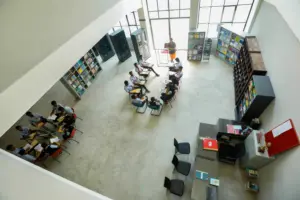
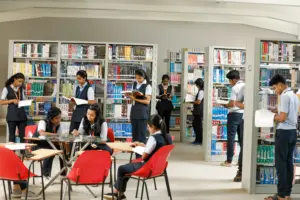
- Comfortable Ambiance: Spacious, well-ventilated reading rooms with a seating capacity designed for focused, long-duration study.
- Smart Notes Access: Integration with the Centre for Smart Notes Research & Innovation (CSNRI) for structured learning materials.
Departmental Libraries: Specialized Knowledge Hubs
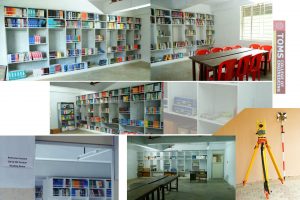
While the Central Library serves as the academic core, Toms College recognizes that specialized research requires immediate access to niche resources. Each of our Academic Departments maintains its own dedicated Departmental Library, functioning as a specialized extension of the main library.
These localized hubs are curated to meet the specific technical and research needs of students and faculty within their respective disciplines.
Key Features of Departmental Libraries:
- Subject-Specific Collections: Each library houses a curated selection of core textbooks, specialized reference manuals, and project reports specific to the department
- Project & Seminar Archives: Students have exclusive access to previous years’ Degree, B.Tech Projects, Diploma Project Reports, and Seminar Thesis, providing a valuable roadmap for their own research and practical work.
- Immediate Accessibility: Located within the department blocks, these libraries allow students to consult technical data, codes, and handbooks during laboratory hours or between lectures without leaving the building.
- Faculty Curated: Collections are frequently updated based on the recommendations of department heads and subject matter experts to ensure students stay aligned with the current industry syllabus.
Empowering Research & Innovation
The Departmental Libraries serve as a quiet space for group discussions and collaborative research. By bridging the gap between classroom theory and the vast resources of the Central Library, these specialized sections ensure that every student at Toms College has the tools they need to master their specific field of engineering.
Services provided in the library
- News Paper Clipping Service
- Curriculum Support
- Information Alerts
- Current Affairs Awareness Service
- Selective Dissemination of Information
- Reference Service
- Research reference Services
- Reprographic Services
- User Instruction and Orientation
- NDL (National Digital Library) facility
- NPTEL Facility
- Online Journal and Print Journal
- Staff and students of the College are eligible for the membership and to use the facilities and resources of the Library.
- Membership application in the prescribed format shall be duly filled and approved by the principal in the case of the staff, and by the concerned staff advisor in the case of students be furnished.
- Visitors shall enter their name, status, membership number in the Gate register at the time of entry.
- Library open from 9.00 am to 5.00 pm on working days.( Circulation time- 9am to 4.30pm)
- All personnel belongings such as text books, note books, files, bags, umbrellas etc. should be kept in the property counter. However calculators and plain papers for taking note can be brought inside the library.
- Books in the Reference section are not open for borrowing.
- Use of mobile phones is strictly prohibited. Strict silence should be observed within the Library.
- Students are using proper dress code in the Library.
- Students shall have their identity card with them while in the Library and shall produce the issue counter.
- Writing or underlining in the books, periodicals, maps, charts etc. is forbid. The person is whose name a book/s is issued shall be held responsible for the care of the same. He/She will have to bear the compensation for any damage or loss. If books borrowed from the Library are lost, the matter must be reported to the Librarian immediately. The member has to replace the same or later edition of the same books lost/damaged within a week’s time. If the replacement is not possible following will be the procedure to recover the cost of the book lost/damaged.
- For a foreign book: The cost of the book converted as per current conversion rate for the foreign currency plus 200% of the cost, will be recovered.
- For an Indian book: Printed price of the book plus 200% of the cost will be recovered.
- Periodicals: Same as above.
- Students are eligible to borrow two books at a time from Library. Faculty members are eligible to borrow five books and technical, administrative staff members are eligible to borrow two books at a time.
- Librarian shall have the right to recall at any time any book issued from the Library.
- Period of borrowing will be fourteen days including the day of the issue. If the member fails to return the book on the 15th day, a fine of Rs. 1 per day, per book, will be levied during the first week, Rs. 2 per day per book during the second week, and Rs. 5 per day thereafter.
- Members are not supposed to sub-lend books borrowed from the Library.
- Periodicals and CDs are regarded as reference material.
- All books borrowed should be returned at the end of the semester examinations.
- A student needs to get Clarence before registering to the next semester. Also a student leaving the institution before, or after completing the course, has to produce a ‘No Dues Certificate’ from the Librarian for getting any certificate or reimbursement of the caution deposit from the college.
- Students shall not attempt to alter Library seating arrangements.
- Library Rules are liable to change from time to time.
Membership is open to all in TOMS College
Help Desk-Email: librarian@toms.ac.in
National Digital Library of India (NDLI) is a virtual repository of learning resources which is not just a repository with search/browse facilities but provides a host of services for the learner community. It is sponsored and mentored by Ministry of Education, Government of India, through its National Mission on Education through Information and Communication Technology (NMEICT). Filtered and federated searching is employed to facilitate focused searching so that learners can find the right resource with least effort and in minimum time. NDLI provides user group-specific services such as Examination Preparatory for School and College students and job aspirants. Services for Researchers and general learners are also provided. NDLI is designed to hold content of any language and provides interface support for 10 most widely used Indian languages. It is built to provide support for all academic levels including researchers and life-long learners, all disciplines, all popular forms of access devices and differently-abled learners. It is designed to enable people to learn and prepare from best practices from all over the world and to facilitate researchers to perform inter-linked exploration from multiple sources. It is developed, operated and maintained from Indian Institute of Technology Kharagpur.
https://ndl.iitkgp.ac.in/
National Digital Library of India Club (NDLI Club) is an enabler of career progression for students, job seekers, researchers and learners. NDLI Clubs are set up in institutes and nodal bodies, and these Clubs conduct events to facilitate students to develop knowledge, skill and traits beyond regular curriculum which are essential for their progression in respective professional domain. The events may be either physical or virtual. Virtual events are web-based and are conducted through the NDLI Club portal.
TOMS College NDLI CLUB
Registration Number : INKLNC4Y98QGXEC
TOMS College of Engineering enrolled as a NDLI club member on 27/3/2021 .
There are 410 registered members (as on 3 Jul. 2021) in this club. The club will conduct events and programmes frequently. The certificates will be issued by MHRD Govt. of India & IIT Kharagpur.
https://club.ndl.iitkgp.ac.in/club-home
TOMS College NDLI CLUB AUTHORITIES
Patron : Dr, A J PAUL
President : Mr. Joby Joseph
Secretary : Mr. Kalesh Gopalan
Executive Member : Ms. Erlin Antony
Associated Executive Members : Ms. Shijina B
Mr. Rahul
Mr. Arjun Raj S
NDLI Certificate 2021-22
NDLI Certificate 2022-23
NPTEL has been offering self-study courses across engineering, humanities and science streams for more than a decade. These are available at: http://nptel.ac.in. From March 2014 NPTEL has been offering online certification for its courses, the highlight being the certification exam through which the student gets an opportunity to earn a certificate form the IITs!
https://nptel.ac.in/
SWAYAM is a programme initiated by Government of India and designed to achieve the three cardinal principles of Education Policy viz., access, equity and quality. The objective of this effort is to take the best teaching learning resources to all, including the most disadvantaged. SWAYAM seeks to bridge the digital divide for students who have hitherto remained untouched by the digital revolution and have not been able to join the mainstream of the knowledge economy.
https://swayam.gov.in/
The Rare Book Society of India was the first of its kind when it was founded in October 2009. It is a virtual space for rare book collectors and history enthusiasts to read, discuss, rediscover and download lost books.Importantly, it aims to highlight the understanding that there is always more than one truth in history! Sourcing from digital libraries such as The Internet Archive, Google Books, Wikipedia and the online collections of various museums around the world, RBSI has curated these rare books and images, and presented them in a context that gives them relevance and shows each piece as a part of a grander whole.
Despite being an ancient literary civilization and having one of the largest literary treasures of hand-written and printed material, India does not have a single Society for rare book collectors. This is an attempt to create a forum where those elusive connoisseurs come together to discuss and share their knowledge on Indian rare books. RBSI showcases rare Indian books, prints and art, that have been digitized, with the purpose of bringing these lost words to life. Through this open virtual platform, members of RBSI can create a digital collection of rare and valuable books by downloading the digitised books that are made available here. What started of as a group for rare book collectors has now transformed into a forum for history enthusiasts, scholars and of course the silent curious. Discussions and comments range from sanguine to educative to irreverent, all providing for an interesting cerebral buzz, every day of the week.
Many of these books might be considered to be history, opinion or plain propaganda – but the aim is to show that there is no wasteful source in the study of history, and there is only an added perspective. More importantly, by reading more than one version of a historical event at this site we begin to understand that there is more than one truth in history, and that in order to learn history, one must also first learn to unlearn.
All material posted on this site are sourced from the public domain and Rare Book Society of India explicitly states that it does not hold copyrights on any of this material.
https://www.rarebooksocietyofindia.org/
Launched in 2001 by Informatics India Limited, J-Gate is an electronic gateway to global e-journal literature. J-Gate provides seamless access to millions of journal articles. The J-Gate platform is fronted by a simple, intuitive, and easy-to-use interface, and also gives users complete control over search filters. By allowing users to access content from a wide variety of publishers on a single platform, J-Gate exponentially increases journal usage.
jgatenext.com
e-PG Pathshala is an initiative of the MHRD under its National Mission on Education through ICT (NME-ICT) being executed by the UGC. The content and its quality being the key component of education system, high quality, curriculum-based, interactive e-content in 70 subjects across all disciplines of social sciences, arts, fine arts and humanities, natural & mathematical sciences, linguistics and languages have been developed by the subject experts working in Indian universities and other R & D institutes across the country. Every subject had a team of principal investigator, paper coordinators, content writers, content reviewers, Language editors and multimedia team.
https://epgp.inflibnet.ac.in/
 APPLY NOW
 FEE STRUCTURE