April 28, 2026
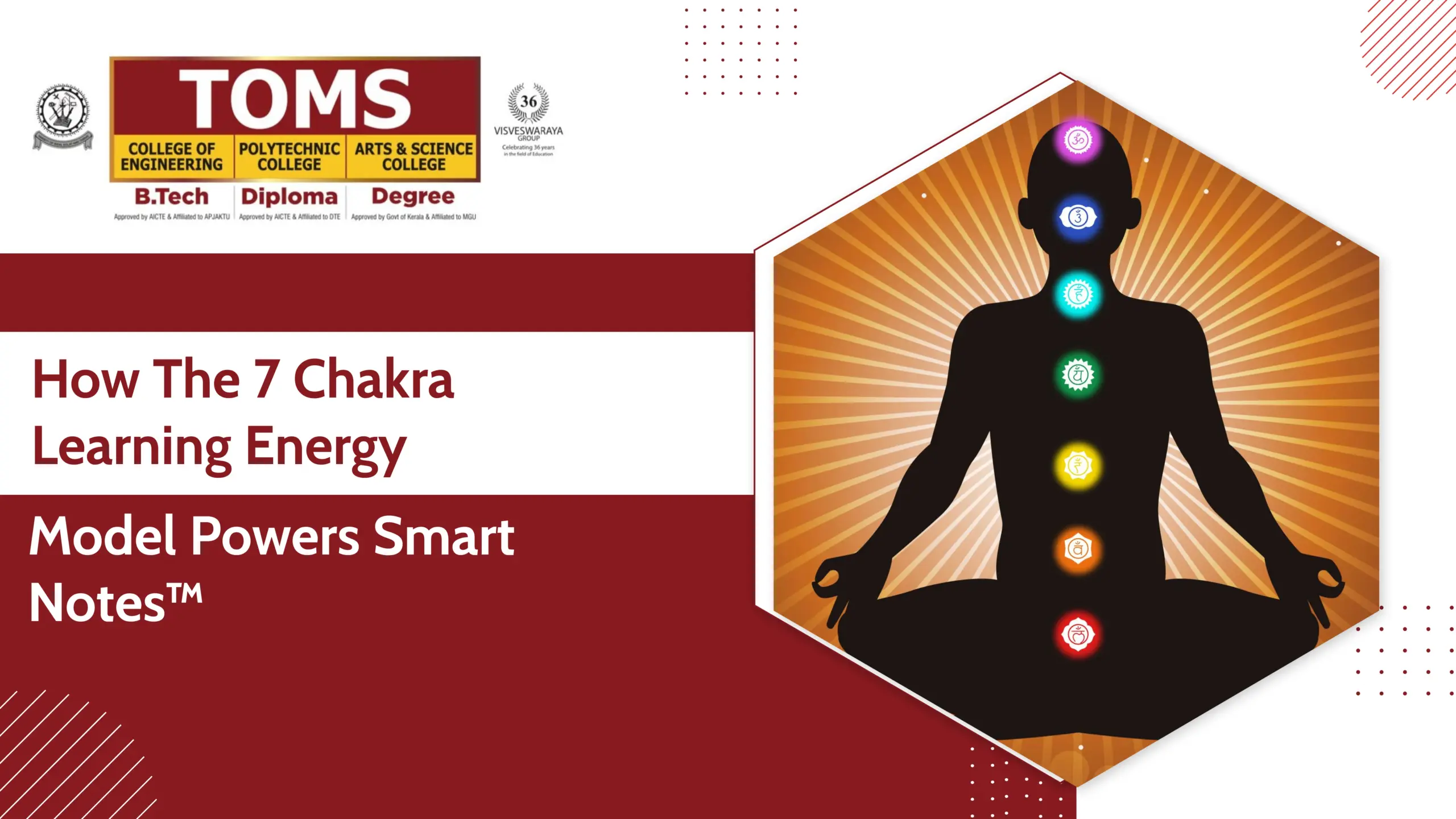
Is it the amount of time you put in that determines whether or not you'll do well on an exam? Is hard work all you need to be successful? At TOMS College of Engineering, it is not about the individual putting in effort; instead, the key ingredient of success is having some sort of system or structure. For over thirty years Chairman Tom T. Joseph has been developing a structure or way of learning that turns unstructured inputs into high performance on exams, through the 7 Chakra Learning Model that is at the center of this learning philosophy.
The 7 Chakra Learning Model is not a mystical way of learning but rather a way of defining how knowledge goes from a lecture hall (source) and flows through your brain (processor) in order to produce quality output (results). Tom T. Joseph's Smart Notes™ use this model to help any student transition from being confused during their first semester of college to being able to consistently perform well on exams throughout all eight semesters.
What Is the 7 Chakra Learning Energy Model?
The 7 Chakra Learning Energy Model is a structured framework that explains how information transforms into performance. Instead of treating studying as random effort, it organizes learning into seven progressive layers–from input to excellence. Each layer activates a specific mental process, ensuring that knowledge is not just collected but understood, remembered, and applied. By following this flow, students reduce confusion, improve clarity, and turn everyday study sessions into a consistent, outcome-driven system for academic success.
The One-Minute Story
Think of learning as energy. Right now, that energy sits trapped inside messy notebooks, half-understood concepts, and unrevised chapters. The 7 Chakra Learning Model gives that energy a pathway to flow – upward through seven distinct layers, each one activated by a specific Smart Notes™ habit.
The journey looks like this:
Tidy Inputs → Clean Structure → Deep Understanding → Strong Memory → Quick Recall → Sharp Application → Top Performance
Each layer builds on the one below. Skip a layer, and energy leaks. Follow all seven, and studying becomes faster, lighter, and far more effective.
Who Should Use It (and When)
| Student Type |
Primary Benefit |
| Beginners |
Tame information overload with structure from day one |
| Mid-semester students |
Convert existing notes into recall-ready, exam-friendly pages |
| Exam crunchers |
Turn pages into answer templates and timed practice sprints |
The 7 Learning Chakras (Layers) Explained
The seven learning chakras represent the complete journey of mastering a topic, each focusing on a distinct function in the learning process. From gathering information to presenting it effectively in exams, every layer builds upon the previous one. This structured progression ensures that no stage is skipped, preventing weak links in understanding or recall. Together, these layers create a reliable system where effort compounds over time, helping students convert simple notes into powerful tools for performance.
1. Knowledge Chakra (Input Layer) – "Collect with Intent"
Goal: Receive information cleanly from lectures, books, discussions, and digital content.
The first chakra is about quality of input, not quantity. Most students make the mistake of trying to capture everything – copying slides verbatim, filling pages with words they haven't processed. The Knowledge Chakra asks you to slow down and distill first.
Mini-ritual (5–7 minutes after every class):
- List 5 core points from the session
- Note 2 unclear items to ask or clarify before the next class
- Resist copying – paraphrase in your own words instead
Trap to avoid: Verbatim slide copying. Your notes should reflect your understanding, not your lecturer's slides.
- 2. Structure Chakra (Organization Layer) – "Arrange to Understand"
Goal: Shape raw inputs into headings, sub-headings, bullets, and flow arrows.
A structured page is not just prettier – it is cognitively easier to process. When your brain can see the shape of information, it builds mental maps faster.
Structure kit for every Smart Notes™ page:
- H1 – Main topic title
- H2 – Sub-topics (2–4 per page)
- 4–7 bullets per sub-topic
- Short cause → effect lines for each major concept
- One micro-diagram (even a rough sketch counts)
Instant win: One flow sketch per topic beats walls of text every time. Stick figures and arrows are perfectly fine – clarity matters, not artistic skill.
- Understanding Chakra (Concept Layer) – "Make It Click"
Goal: Link ideas so they make logical sense together – not just co-exist on a page.
This is where most students stop short. They organize their notes beautifully but never force themselves to explain why things connect. The Understanding Chakra fixes that.
Linking prompts to write for every bullet:
- "Because…" – state the cause
- "Therefore…" – state the consequence
- "Compared with…" – highlight the contrast
- "Leads to…" – trace the outcome
Quick test: Record yourself explaining the topic in 30 seconds. If you stall or fumble, go back and add one more connecting sentence or example to your notes.
- Memory Chakra (Retention Layer) – "Lock It In"
Goal: Move knowledge from working memory into long-term storage.
One reading session does not create memory – repetition at increasing intervals does. The 7 Chakra Learning Model applies spacing science to Smart Notes™ in a simple, trackable path.
Spacing schedule:
- Same day – First pass (full review)
- Day 3 – Second pass (2–5 minutes per page)
- Day 7 – Third pass
- Pre-exam – Final flash pass
Compression trick:
- After your first review → reduce each page to a half-page summary
- After your second review → reduce to 8–10 keyword cues
The act of compressing is itself a memory-building exercise. You are forcing your brain to decide what matters most.
- Recall Chakra (Retrieval Layer) – "Answer on Cue"
Goal: Retrieve information fast under real exam conditions.
Understanding is not the same as recall. A student can know a concept deeply and still blank under exam pressure. The Recall Chakra trains the retrieval pathway, not just storage.
5-second starters – pre-write the opening line for every common answer type:
| Answer Type |
First-Line Formula |
| Definition |
"[Term] is defined as…" |
| Law / Principle |
"[Law] states that…" |
| Formula |
"The formula for [X] is… where…" |
| Thesis / Argument |
"[Topic] is significant because…" |
By rehearsing first lines, you eliminate the blank-page freeze that costs marks in the opening seconds of every answer.
- Application Chakra (Problem-Solving Layer) – "Prove It Works"
Goal: Apply knowledge to numericals, case studies, design prompts, and scenario questions.
Theory without application is incomplete learning. KTU, AMIE, and other engineering exams consistently reward students who can use concepts – not just state them. The Application Chakra builds that muscle.
The 1-2-1 Rule (practice per topic per week):
- 1 basic problem (build confidence)
- 2 mid-level problems (build competence)
- 1 twist / edge case problem (build flexibility)
Case study frame (5 bullets max):
- Context – What is the situation?
- Principle – Which concept applies?
- Steps – How is it applied?
- Result – What is the outcome?
- Pitfalls – What could go wrong?
- Excellence Chakra (Performance Layer) – "Write Like a Topper"
Goal: Deliver clear, scorable answers under timed exam conditions.
The final chakra is about translation – converting everything you have learned into the kind of written answers that examiners reward. This is where students who have followed all six layers finally convert study time into marks.
Answer writing template:
- Definition – Define the key term or concept clearly
- Key Points – List the 3–5 most important aspects
- Explanation – Expand with cause-effect links and theory
- Diagram / Example – Illustrate with a neat sketch or real-world example
- Conclusion – Wrap up with a crisp one or two sentence summary
Time guard:
- Aim to use 80–85% of allocated time per question
- Reserve 15–20% for a quick review and polish pass
- Never sacrifice structure for speed – a shorter, well-structured answer outscores a longer, chaotic one
Energy Flow Model
The Energy Flow Model visualizes learning as an upward movement through interconnected layers, where each stage strengthens the next. Rather than studying in isolated bursts, this approach encourages a continuous cycle of improvement. As students revisit topics, the flow becomes faster and more efficient due to prior structure and familiarity. This model not only highlights how progress happens but also reveals where breakdowns occur, allowing learners to fix gaps and maintain steady academic growth.
The Ladder You Climb Every Week
- Knowledge ← Collect with intent
- Structure ← Arrange to understand
- Understanding ← Make it click
- Memory ← Lock it in
- Recall ← Answer on cue
- Application ← Prove it works
- Excellence ← Write like a topper
The key insight of the 7 Chakra Learning Model is that this ladder is a cycle, not a one-time climb. Each time you revisit a topic, you move through the layers faster because the structure you built earlier reduces the mental load at every stage. Effort compounds.
Where Energy Leaks (and How to Fix It)
| Symptom |
Root Cause |
Fix |
| Pretty notes, weak exam recall |
Structure without retrieval practice |
2-minute cover-test per page after every review |
| Strong theory, poor problem solving |
Application layer skipped |
1-2-1 Rule every week per topic |
| Running out of time in exams |
No answer template or timing practice |
Pre-write first lines + practice 80% time pacing |
| Forgetting after one week |
No spacing schedule |
Day 1 → Day 3 → Day 7 revision path |
Scientific Interpretation
Behind the simplicity of the 7 Chakra Learning Model lies strong alignment with cognitive science principles. It integrates how the brain processes, stores, and retrieves information in an efficient sequence. Structured organization reduces mental overload, spaced repetition strengthens memory, and active recall improves retrieval speed. Additionally, applying knowledge builds real understanding beyond theory. This scientific foundation ensures that the model is not just intuitive but also practical, helping students learn smarter by working with their brain, not against it.
Four Engines Under the Hood
The 7 Chakra Learning Model is not just good intuition – it aligns closely with four well-established principles from cognitive science:
- Cognition: Organizing content into structured formats reduces cognitive load, freeing mental bandwidth for deeper thinking
- Memory: Spaced, structured review passes consolidate knowledge into long-term memory more effectively than massed re-reading
- Retrieval: Actively practicing recall (cover-test, first-line starters) pulls answers out faster than passive review
- Transfer: Applying knowledge to problems and cases builds neural pathways that connect knowing to doing
What Changes in Your Brain-Habits
When you follow the 7 Chakra Learning Model consistently, three fundamental study habits shift:
- You stop re-reading and start re-calling
- You stop copying and start compressing
- You stop hoping and start timing
That habit shift – not any single technique – is what raises scores over time. TOMS College of Engineering students have demonstrated this consistently across KTU, AMIE, and MGU examinations for decades.
Core Principle Behind Smart Notes™
At the heart of Smart Notes™ lies a simple but powerful principle: structured knowledge leads to better thinking and stronger performance. Instead of passively recording information, students actively shape, compress, and test what they learn. This transformation–from raw input to refined output–creates clarity and boosts confidence. By consistently applying this principle, learners develop habits that improve focus, retention, and recall, ultimately turning their notes into a reliable system that directly supports higher exam scores.
Structured Knowledge → Cognitive Activation → Memory Strength → Recall Power → Academic Excellence
The 10-Line Manifesto
Every Smart Notes™ page at TOMS is built on ten non-negotiable principles:
- Capture less, distil more
- Give every page a shape
- One cause → effect line per idea
- Shrink your notes each pass
- Test recall with your eyes closed
- Start answers with first-line cues
- Practice 1-2-1 problems weekly
- Draw one tiny diagram per topic
- Write for the examiner's eyes
- Finish every answer with time to spare
How to Use the 7-Chakra Model in Daily Study
Applying the 7-Chakra Model daily turns studying into a focused, repeatable process rather than an overwhelming task. By dividing study sessions into short, purposeful phases, students can cover structure, understanding, recall, and application within a single cycle. This approach ensures balanced learning without burnout. Over time, these cycles build momentum, making revision faster and more effective. With consistent use, students gain control over their study routine and steadily improve both efficiency and performance.
The 25-Minute Mini-Cycle (Pomodoro-Ready)
This session format fits inside one Pomodoro block and covers all seven chakra layers for a single topic:
| Minutes |
Activity |
Chakra |
| 0–7 |
Build headings, 4–7 bullets, 1 flow arrow |
Structure |
| 7–12 |
Add "because / therefore / compare" links |
Understanding |
| 12–17 |
Cover → list from memory → check → patch gaps |
Recall |
| 17–23 |
Solve one problem or case (1-2-1 rotation) |
Application |
| 23–25 |
Write first-line cue + 10-word micro-summary |
Excellence |
Take a 5-minute break, then repeat for the next topic.
Weekly Review Rhythm (Light but Powerful)
Consistency over intensity. A simple weekly schedule keeps all seven chakras active without burning out:
- Monday / Wednesday / Friday: Two topics → spacing passes (2–5 minutes per page)
- Saturday: Application lab – solve 1-2-1 problems per topic
- Sunday: 30-minute mock answer block using the Definition → Points → Explanation → Example → Conclusion frame
Conclusion
The 7 Chakra Learning Model uses Thomas T. Joseph’s Smart Notes™ to create a consistent and science-based method for working through an entire course from basic information all the way through to being ready for an exam and doing an excellent job on that exam. This approach does not require students to study longer, but rather to study in a more efficient order by first building the structure of the material (what knowledge), then understanding the structure (how you process), then remembering the information that has been learned (how to recall), and finally, applying what you have learned to show results during a final examination (how are the results demonstrated & organized).
Using Clearly laid out notes, quick retrieval of information, experience in problem solving and a proven answer organization process allows students who have used this system to earn points without studying longer. They also replace chaos with order.
This philosophy has been in effect at TOMS College of Engineering since 1988 and is now available to all students who want to learn in the manner described above through the use of the 7 step process.
FAQs
Q1. Can I use the 7 Chakra Learning Model for both quantitative and theory subjects?
Yes. Layers 1–4 (Knowledge, Structure, Understanding, Memory) apply equally to theory. Layers 5–6 (Recall and Application) adjust naturally – for quantitative subjects, the 1-2-1 Rule dominates; for theory subjects, the answer template and first-line cues take priority.
Q2. How many pages per topic is ideal?
Aim for 1–2 structured Smart Notes™ pages per topic after compression. A topic that originally spans 5–6 pages of raw notes should condense to 1 page of cues after your second review pass.
Q3. I am short on time – what is the fastest win?
Jump straight to Layer 5 (Recall). Take any existing notes, cover them, and write what you remember. Check the gaps. Patch them. This single habit delivers the fastest improvement in exam scores for students who are close to their exam date.
Q4. Do I need perfect diagrams?
No. The goal of a diagram is clarity, not beauty. A rough sketch with labelled arrows communicates relationships to an examiner just as effectively as a polished drawing – and earns the same marks.
Q5. How do I know I am improving?
Track two things: (1) the time it takes to recall a full topic from cue cards alone, and (2) your score on timed mock answers. If both are improving week-on-week, the 7 Chakra Learning Model is working exactly as designed.
 APPLY NOW
 FEE STRUCTURE