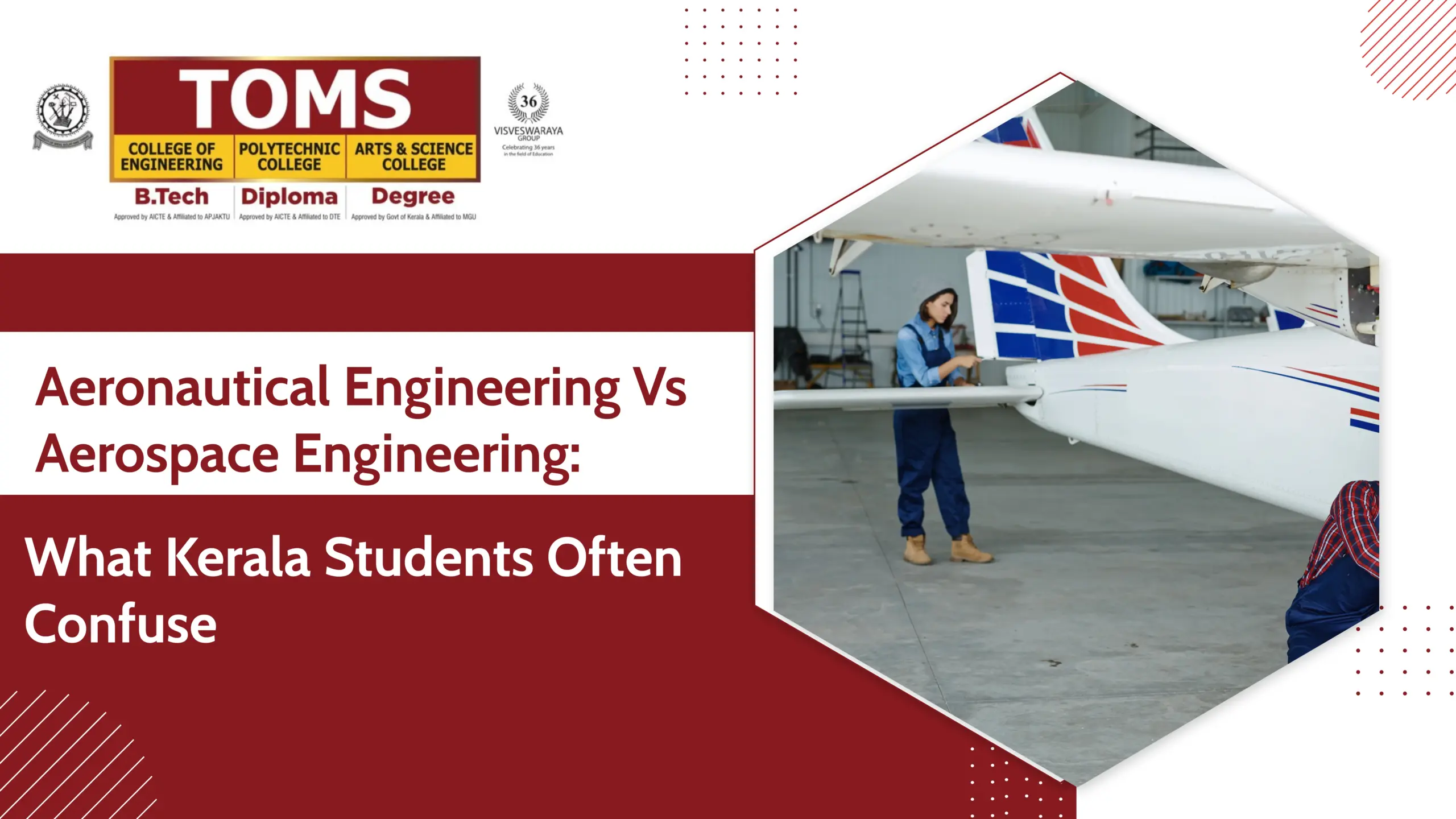
Aeronautical Engineering centres around vehicles that fly within the Earth's atmosphere, such as aeroplanes, drones, fighter jets, helicopters, gliders, etc., whereas Aerospace Engineering is a broader term that focuses on atmospheric aircraft and spacecraft operating in outer space, such as satellites, space stations, interplanetary probs etc. Students often get confused between the two and don't realise that Aeronautical Engineering is a specialised branch of Aerospace Engineering.
The curriculum focus for both courses is also different. Aeronautical studies focus on aerodynamics, aircraft structure, flight mechanics, and jet propulsion. Whereas aerospace studies focus on atmospheric concepts along with rocketry, zero-gravity physics, orbital mechanics, etc. Also, the aeronautical career scope is tailored for commercial airlines, civil aviation, airport maintenance, and defence aviation. Whereas Aerospace Engineering opens pathways for employment in national agencies like ISRO, private spaceflight firms and defence research.
Why This Confusion Happens — and Why It Matters Before You Apply
Kerala students often get confused between Aeronautical Engineering and Aerospace Engineering because both courses deal with flying machines. The curriculum often includes similar core subjects, overlapping engineering principles, and many colleges use the terms interchangeably. Knowing the difference between the two courses will help students choose the right course, study a career-oriented curriculum, find employment in a targeted industry and satisfy personal passion for flight or space. However, choosing the wrong program means building technical skills and knowledge for an entirely different career.
The Two Terms Sound Almost Identical — But They Define Different Academic Programs, Different Curriculum Emphases and Different Career Trajectories
- Students often assume that aeronautics and Aerospace Engineering are the same course.
- Students miss the key focus of both programs; Aeronautical Engineering deals with aeroplanes, drones, and helicopters, while Aerospace Engineering deals with space probes, rockets, and satellites.
- Both programs cover similar subjects like mathematics, physics, thermodynamics, and fluid dynamics.
- Students don't realise that different foundational skills and knowledge lead to different career and industry scope.
Students Who Apply for the Wrong Program Often Discover the Mismatch Only After Their First Semester — Why Clarity Before Application Is Critical
The core differences students often miss between Aeronautical Engineering and Aerospace Engineering courses are their operating environment, vehicle type, propulsion, and materials used. The realisation of pursuing the wrong program often happens after the completion of the first semester. Because in the first semester, most universities teach foundational subjects like calculus, physics, and basic fluid dynamics. Which lead to students aiming for careers in commercial airlines ending up enrolling in a heavy space program. This also leads to students choosing a career they never intended in the first place.
What Aeronautical Engineering Actually Is
An Aeronautical Engineering course is designed for students who are interested in designing, building, testing and maintaining flying vehicles used within the Earth's atmosphere. The program deals with aeroplanes, helicopters, gliders, drones, and military jets. Many top Aeronautical Engineering Colleges in Kerala, such as TOMS College of Engineering, offer this course as a 4-year undergraduate degree.
The key focus of the program is Aerodynamics (how air moves around objects), Propulsion Systems (jet engines, turbines, and motors), Aircraft Structures and Avionics (navigation, electronic, and control systems used in the cockpit).
Many leading Aeronautical Engineering Colleges in Kerala, like TOMS, cover core subjects like Fluid Mechanics & Thermodynamics, Flight Mechanics, Computational Fluid Dynamics (CFD), Finite Element Analysis (FEA) and material science.
Aeronautical Engineering Is the Branch of Engineering Concerned With the Design, Construction, and Study of the Science Behind Aircraft That Operate Within Earth's Atmosphere
Aeronautical Engineering is the specialised branch of Aerospace Engineering. It is solely focused on designing, constructing, and studying the science behind the aircraft that operate within Earth's atmosphere. The vehicles typically include helicopters, rotorcraft, Commercial & military aeroplanes, Drones, unmanned aerial vehicles, gliders, and airships.
Core Focus Areas — Aerodynamics, Aircraft Structures, Propulsion Systems, Flight Mechanics and Avionics for Atmospheric Flight Vehicles
The core focus for atmospheric flight vehicles includes:
- Key Focus: It studies how air moves around a flying object.
- Key Forces: Provide lift so the plane stays airborne and drag to create backward resistance.
- Key Focus: Designing the physical frame of the plane.
- Key Material: Lightweight aluminium alloys, titanium, and advanced composite materials like carbon fibre.
- Key Focus: Generating the power and thrust required to push the aircraft against atmospheric resistance.
- Key Process: Optimise fuel combustion, create high-energy gas, and thrust backwards at a high speed.
- Key Focus: Analyse how aircraft move, perform, and respond under the influence of gravity, aerodynamic forces, and thrust
- Key Areas: Calculates the climb rates, range, turning capability, and landing distances
- Key Focus: It covers all the electrical, electronics, and software used on an aircraft.
- Key Equipment: Autopilots, radar, flight management computers, GPS, radio links, sensor instrumentation, etc.
What Aerospace Engineering Is — And Where the Two Diverge
Aerospace Engineering is a broader field that focuses on designing, building, testing and maintaining aircraft, satellites, spacecraft, and missiles. It covers two main branches: aeronautics, that focus on flight inside Earth's atmosphere and astronautics, that focus on flight outside Earth's atmosphere. It is a 4-year undergraduate degree course offered by many renowned Aeronautical Engineering Colleges in Kerala.
Though both courses are often used interchangeably, they differ in operating environment, scope, and core technical challenges.
- Aerospace Engineering strictly deals with zero gravity, orbital mechanics, extreme thermal shifts, and vacuum conditions.
- The design focuses on radiation shielding and thermal protection systems for space design.
- Instead of atmospheric intake, aerospace engines carry oxidisers and use rocket propulsion.
Aerospace Engineering Extends Beyond the Atmosphere — Covering Both Aircraft and Spacecraft, Including Satellites, Rockets and Space Exploration Vehicles
Aerospace Engineering extends beyond the atmosphere because it designs, builds, tests, and maintains vehicles used both in Earth's atmosphere and outer space. It includes two main braces such as Aeronautical engineering and astronautical engineering. It extends beyond the atmosphere and covers both aircraft and spacecraft because they share core foundational roots like physics, materials science, and computer control systems. Often, spacecraft use avionics similar to those in an aircraft for core navigation, flight control, and communications, etc.
Why Most Kerala Engineering Colleges Offering This Field Teach Aeronautical Engineering Specifically — and What That Means for Students Targeting Aviation and Aircraft Careers
Top Aeronautical Engineering Colleges in Kerala, such as TOMS, offer a B.Tech in Aeronautical Engineering course for the duration of 4-years at the UG level. Many colleges teach Aeronautical Engineering specifically because many students in Kerala have a strong interest in aircraft, flight technology, and defence systems.
Hence, colleges often launch various specialised branches with industry-oriented curricula, specialised labs and infrastructure to meet the rising demand. Students will be given more practical training and workshop opportunities in aerodynamics, propulsion, and avionics. They will focus more on core engineering and design to build and test flight systems.
TOMS College's BTech in Aeronautical Engineering — What the Program Delivers
TOMS College of Engineering offers a 4-year B.Tech in Aeronautical Engineering, divided into 8 semesters. It is an undergraduate program approved by the AICTE and is ideal for students passionate about designing, testing, manufacturing, and maintaining flight-capable vehicles. The program bridges the gap between mechanical physics and advanced aerospace systems.
The program equips students with core technical skills and knowledge of aerodynamics, avionics, structural design, and propulsion to solve complex aeronautical problems. Students will develop strong communication skills, project management capabilities and an understanding of safety and ethics in the aviation industry.
With the blend of theoretical framework and practical training, students will be able to use advanced tools to design flight systems and maintain aircraft operation in the real world.
AICTE-Approved and KTU-Affiliated BTech in Aeronautical Engineering at TOMS College of Engineering, Kottayam — a Program Focused on the Design, Construction and Scientific Study of Atmospheric Flight Systems
TOMS College BTech Aeronautical Engineering course is affiliated with KTU and is recognised by AICTE. It is one of the popular Aeronautical Engineering Colleges in Kerala, with an annual intake of only 60 students. The curriculum is aligned with the standards of the National Board of Accreditation (NBA), focusing on building core technical competencies and preparing students for global airlines, maintenance organisations, research laboratories and defence sectors.
Students will use advanced Computational Fluid Dynamics (CFD) and Finite Element Analysis (FEA) tools to create and evaluate aerodynamic bodies. They will be able to troubleshoot, service, and maintain engines, powerplants, mechanical linkages, control surfaces, and avionics instruments.
State-of-the-Art Infrastructure, Experienced Faculty and a Practical Learning Approach — What Aeronautical Engineering Students Experience at TOMS College
Many Aeronautical Engineering Colleges in Kerala, such as TOMS College of Engineering, have a state-of-the-art infrastructure, experienced faculty and a practical learning approach. Since textbooks cannot level up to a real-world jet engine or a fuselage assembly, students at TOMS are provided access to an on-campus, fully equipped training hangar with two operational live aircraft.
- Learjet 25B (Twin-Engine Business Jet) - It is a fully intact, 10-seater corporate jet used for active lab learning. Students can study aircraft structures, hydraulic landing gear, cabin pressurisation systems, commercial flight deck instrumentation configurations, pneumatic loops, and advanced avionics bays.
- Cessna 150 (Light Aircraft) - It is a two-seater trainer model used for live demonstration of structural rigging, flight control surface linkages, weight and balance calculations and aerodynamic geometry.
Career Paths — Where Aeronautical Engineering Graduates From Kerala Work
Students graduating from Aeronautical Engineering Colleges in Kerala can commonly seek employment in domestic and international airlines, government research organisations, and aviation maintenance sectors.
| Work Sector |
Job Role |
| Core Aviation & Maintenance |
- Aircraft Maintenance Engineer (AME) or Technician
- Avionics and Electrical System Engineer
- Line & Base Maintenance Engineer
|
| Space Research & Government Sector |
- Scientist or Aerospace Engineer
- Design and Propulsion Engineer
|
| Design, Manufacturing & Private Tech |
- Aircraft Design or Structural Engineer
- UAV or Drone Developer
- Flight Simulation or Software Engineer
|
ISRO, HAL, Defence Research and Development, Commercial Aviation, Maintenance, Repair and Overhaul and the Growing Indian Aerospace Manufacturing Sector
The Indian aerospace and defence manufacturing industry is undergoing a massive transformation due to indigenisation, large-scale defence orders, and the expansion of public-private partnerships. This results in a rising need for professionals who possess technical knowledge in organisations such as ISRO, HAL, defence, R&D, and even commercial aviation sectors.
- ISRO: Indian Space Research Organisation leads the advancement in space technology and launch systems, working with domestic manufacturing partners like HAL (Hindustan Aeronautics Limited).
- HAL: Hindustan Aeronautics Limited handles the large-scale manufacturing programmes such as LCA Tejas Mk1A, along with international propulsion joint ventures with leading companies like Rolls-Royce and Safran.
- Defence Research and Development (DRDO/ADA: Leads Research and Development for military hardware and combat aircraft through wider industry participation models.
- Commercial Aviation: There is an expansion of defence production to civil aircraft components and regional fleet support, which is backed by integration of the global support chain.
- MRO (Maintenance, Repair and Overhaul): Dedicated military and heavy maintenance facilities are rapidly growing to reduce dependence on foreign support, such as air-defence systems and regional engine service hubs.
How TOMS College's Dedicated Placement Cell Supports Aeronautical Engineering Students in Securing Career Opportunities Across These Sectors
There is a dedicated placement cell for the Aeronautical Engineering course at TOMS Kottayam. The centralised Training and Placement Cell (TPC) manages professional bootcamps, technical interviews, resume optimisation, and corporate placement drives to ensure a smooth transition for students from the academic campus to an aviation runway. Students graduating from TOMS secure entry-level job positions as Junior Aeronautical Engineers, Design Engineers, or Graduate Engineer Trainees (GET).
Some of the top target recruiting airlines and sectors of TOMS College are:
- Commercial Airlines - IndiGo, Air India, SpiceJet, AirAsia
- Manufacturing & OEM - Boeing, Airbus, Bombardier, Dassault Aviation, Embraer
- Research & Space Defence - ISRO, VSSC, DRDO, Indian Air Force / Army / Navy Aviation Wings
Facilities and Support for Aeronautical Engineering Students at TOMS
Students pursuing a B.Tech in Aeronautical Engineering at a top Aeronautical Engineering college in Kerala, such as TOMS, will have access to Advanced Aeronautical Laboratories for hands-on training and practical experience.
| Propulsion & Aero-Engine Lab |
- Boeing Series Engines
- Helicopter Turbo-shaft Engines
- Piston & Jet Propulsion Units
|
| Advanced Propeller Systems Assembly Lab featuring |
- Fixed-Pitch and Variable-Pitch Models
- Maintenance & Calibration Drills
|
| Aerodynamics & Flight Mechanics Lab |
Equipped with subsonic wind tunnels |
| Aircraft Structures Lab |
Containing a universal testing machine (UTM) and photoelastic setups |
| CAD/CAM & Aerospace Simulation Lab |
Workstation terminals running industrial software including ANSYS, CATIA, and MATLAB |
Central Library Facility, Central Computing Facility, Hostel Accommodation, Banking Facility and ATM — the Campus Infrastructure Supporting Aeronautical Engineering Students at Kottayam
TOMS Kottayam offers amazing campus facilities to the students enrolled in the Aeronautical Engineering program.
- Aeronautical lab - Consists of a 10-seater Learjet 25B heavy aircraft and a 2-seater Cessna 150 light aeroplane
- Central Library Facility - Provides access to Digital Library & E-Resources, 1,00,000 reference books, and competitive exam papers.
- Central Computing Facility - Has a high-speed modern computer system with secured wifi connectivity.
- Hostel Accommodation - On-campus residential facilities for both male and female students.
- Banking Facility and ATM - State Bank of Travancore is available within 250 metres of the campus with ATM facility.
Admission Through KEAM — Eligibility, Government Quota Seats, Application Process and What to Prepare for 2026–27 Intake at TOMS College
- Eligibility Criteria: Students must have completed their 10+2 with a minimum of 45% in aggregate from a recognised board. They must have studied Mathematics, Physics, Chemistry, Computer Science, and Biotechnology at school level.
- Government Quota Seats: There are 60 seats allotted to B.Tech in Aeronautical Engineering ( 50% of the seats are reserved for the government quota).
- Entrance Exam: Admission will be based on the academic score and KEAM (Kerala Engineering Architecture Medical) entrance rank.
- Application Process: Fill out the online admission form, appear for the entrance exam (if applicable), pay the application fee and submit documents for verification.
Conclusion
Making a career in Aeronautical Engineering is quite exciting and possible only when you have proper technical knowledge and hands-on experience through internships and practical research projects. TOMS College of Engineering is one of the top Aeronautical Engineering Colleges in Kerala. With its aviation-oriented curriculum, access to Live-Aircraft Training, Advanced Aeronautical Laboratories, and placement drives, students can easily find suitable jobs in commercial aviation, defence, and research & development.
FAQs:
What is the difference between Aeronautical Engineering and Aerospace Engineering?
Aeronautical Engineering is a specialised branch of Aerospace Engineering, focusing on vehicles operating within the Earth's atmosphere, whereas Aerospace Engineering covers vehicles operating both inside and outside Earth's atmosphere.
What does TOMS College's BTech Aeronautical Engineering program cover?
The program covers core specialisations like flight dynamics, propulsion systems, aircraft design, aerospace systems and avionics & systems.
Is TOMS College's BTech Aeronautical Engineering AICTE approved and KTU affiliated?
Yes, the B.Tech Aeronautical Engineering offered by TOMS is approved by the AICTE and affiliated with the APJ Abdul Kalam Technological University (KTU), Kerala.
What career opportunities are available after BTech Aeronautical Engineering from TOMS?
Students can pursue career opportunities such as Aircraft Design Engineer, Avionics Engineer, Propulsion Systems Engineer, Flight Test / Safety Engineer, UAV / Drone Engineer, Aircraft Maintenance Engineer (AME), etc.
What facilities are available for Aeronautical Engineering students at TOMS College?
Students have access to Real Aircraft on Campus, a wind tunnel facility, Advanced Labs and Workshops, mandatory internships, ISRO & VSSC Exhibitions, Departmental Expos & Flight Testing and Placement opportunities.
What entrance exam is required for BTech Aeronautical Engineering at TOMS College?
Students have to appear for and clear the KEAM (Kerala Engineering Architecture Medical) entrance examination.
Does TOMS College offer government quota seats for BTech Aeronautical Engineering?
Yes, TOMS College offers 50% government quota seats for B.Tech Aeronautical Engineering students.
 APPLY NOW
 FEE STRUCTURE