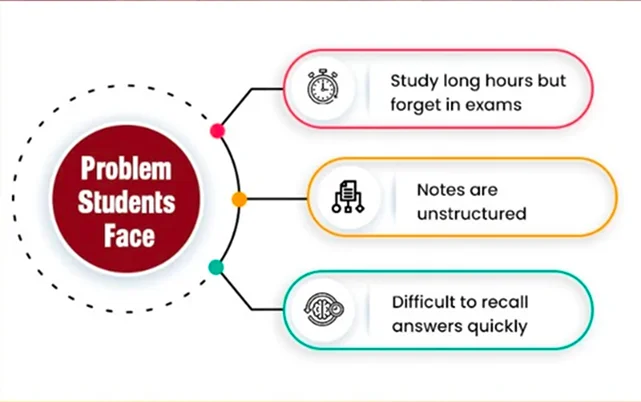
Have you ever had a situation where you worked extremely hard for an exam but still couldn’t remember enough information when taking the exam? This happens to people often, and the cause is not due to lack of trying hard enough. The problem lies in how our brains encode and retrieve information. Smart Notes™ created by Tom T. Joseph at TOMS College of Engineering Kottayam Kerala is designed to resolve this problem.
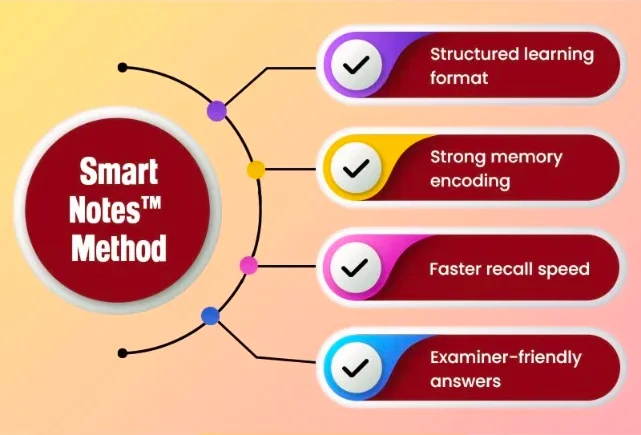
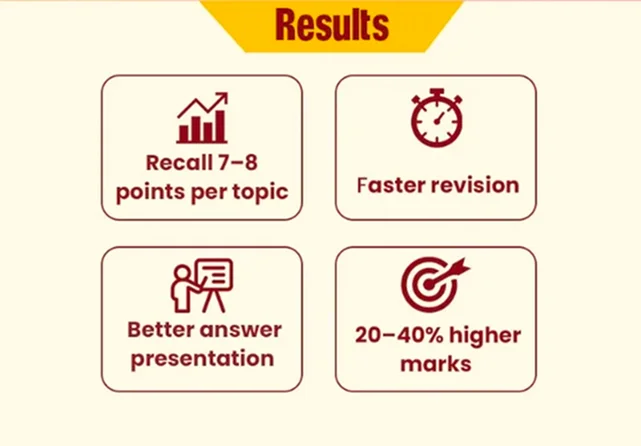
Smart Notes are more than just a better method of recording what you’ve studied; they’re a systematic approach that helps you to encode information in a way that will allow you to remember it under pressure, and they provide you with a method to present answers to the examiner. Consequently, students using Smart Notes consistently perform 20 – 40% higher than they normally would when taking exams and without having studied for an additional hour.
Let’s examine how this works.
What Changes: Not Study Time - Your Brain's Processing and Retrieval Smart Notes™
A lot of students think that the more time they spend studying, the better their grades will be, but research has shown time and again that how you study matters much more than how long you study.
The process of writing down traditional notes is often done in a passive manner. You write down everything you see but without creating any kind of structure to help your mind store or retrieve the information. The Smart Notes™ method will transform this process by providing a structured, logical way of organizing how you collect and store information in a way that mirrors the brain's natural way of creating and recalling memories.
Here's the key difference at a glance:
| Feature |
Traditional Notes |
Smart Notes™ |
| Format |
Random, unstructured |
Logical, structured |
| Memory encoding |
Weak |
Strong (long-term potentiation) |
| Retrieval speed |
Slow |
Fast |
| Exam answer quality |
Inconsistent |
Examiner-friendly |
| Revision time |
2–3 hours per chapter |
20–30 minutes per chapter |
| Points recalled |
3–4 per topic |
7–8 per topic |
When you switch from traditional notes to Smart Notes, you're not changing what you study - you're changing how your brain stores and uses that information.
Retrieval Efficiency: Faster, Clearer Recall in the Exam Hall
Why do marks depend so heavily on retrieval? Because it doesn't matter what you know - it matters what you can recall and write within the exam time limit.
Organised information creates retrieval cues in the brain. The more cues you have, the more you can recall. Smart Notes™ build those cues deliberately by including:
- Clear headings that act as mental bookmarks
- Numbered steps that give your memory a sequence to follow
- Keywords that trigger broader chains of related information
- Logical sequences that make the flow of ideas natural and automatic
The result in the exam hall:
- Without structure → recall 3–4 points per topic
- With Smart Notes™ → recall 7–8 points per topic
More retrieval cues = more recalled points = more marks. It really is that direct.
Answer Presentation Effect: Write What Examiners Love to Read
Here's something students rarely think about: examiners are human. They read hundreds of answer sheets. A well-structured, easy-to-read answer stands out immediately - and it gets better marks.
Smart Notes™ train students to naturally present answers in a format examiners prefer:
- Definition - What is it?
- Classification - What are its types?
- Explanation - How does it work?
- Diagram - Can you show it visually?
- Conclusion - What's the takeaway?
When your answer follows a recognisable, logical pattern, it reduces the effort the examiner needs to evaluate it. That alignment with examiner expectations consistently lifts scores - not because you know more, but because you present what you know more effectively.

<
Stronger Encoding: Make Learning "Stick"
Every time you review structured notes, you strengthen the neural pathways associated with that information. This is the biological process known as long-term potentiation - your brain literally becomes better at holding and accessing that knowledge.
Effect of Smart Notes™ on Memory:
- Stronger memory circuits - repeated structured review builds deeper neural connections
- Longer retention - information stays accessible weeks and months later, not just for the next day
- Easier recall during exams - what went in clearly comes out clearly
This is why Smart Notes™ students don't just perform well right after studying - they perform well when it counts most.
Faster Revision: Compress Chapters into Minutes
One of the biggest practical advantages of the Smart Notes system is how drastically it reduces revision time.
| Revision Method |
Time Required |
| Full textbook chapter |
2–3 hours |
| Smart Notes™ for the same chapter |
20–30 minutes |
That's a time saving of up to 85% per chapter.
Shorter revision sessions mean you can fit in far more revision cycles before an exam. And every extra revision cycle increases retention and strengthens your recall. Instead of reading one chapter twice, you can go through five chapters in the same amount of time. That's an enormous advantage when exams are around the corner.
Less Confusion: Lower Cognitive Interference
Have you ever mixed up two similar formulas, definitions, or concepts in an exam? That's called cognitive interference - when randomly stored information collides in your memory during recall.
Smart Notes™ prevent this by:
- Clearly separating topics with distinct headings and boundaries
- Using visual organisation to show where one concept ends and another begins
- Reducing the chance of similar ideas overlapping in memory
The result is cleaner, more accurate recall - fewer mix-ups, fewer lost marks.
The "Recall Trigger" Chain: One Keyword Starts the Whole Answer
This is one of the most powerful mechanisms in the Smart Notes™ system - associative activation.
Smart Notes™ place keywords in a deliberate sequence. In the exam, recalling just the first keyword triggers the rest of the chain automatically. For example:
Topic: "Advantages of Solar Energy"
Renewable → Non-polluting → Low operating cost → Energy independence → No fuel cost → Scalable
That's a complete answer built from a single trigger word. This associative memory chain helps students keep writing confidently without getting stuck mid-answer - a common problem that costs marks.
Time Management Edge: Think Faster, Write Faster
With a clear structure already in mind from their Smart Notes taking practice, students gain a significant time advantage in the exam hall. They:
- Start answers sooner - no time wasted staring at the question
- Finish earlier - structured thinking speeds up writing
- Use buffer time for checking answers and adding quick extra points
That buffer time at the end of an exam is often where marks are made or lost. Students who finish with time to spare can review, fill gaps, and catch errors. That's a direct mark booster.
Confidence Effect: Lower Anxiety, Clearer Thinking
Exam anxiety is real, and it has a measurable impact on performance. When you walk into an exam knowing your notes are well-organised, structured, and complete, your confidence naturally rises.
That confidence:
- Reduces anxiety, freeing up working memory for actual thinking
- Leads to a calmer, more focused state of mind
- Results in fewer blanks, fewer errors, and stronger overall performance
Students who practise taking Smart Notes regularly report feeling more prepared and less stressed before exams - and that mental edge shows up directly in their results.
The Smart Notes™ Performance Equation
Here's the simplest way to understand why Smart Notes™ work so well:
Marks = Knowledge × Recall Speed × Answer Structure
Most traditional study methods only improve knowledge. They make you know more. But if your recall is slow and your answers are disorganised, that knowledge doesn't fully convert into marks.
Smart Notes™ improve all three variables simultaneously:
| Variable |
Traditional Study |
Smart Notes™ |
| Knowledge |
Improved |
Improved |
| Recall Speed |
Not addressed |
Significantly improved |
| Answer Structure |
Not addressed |
Examiner-friendly format |
When all three factors improve together, the total result rises dramatically - which is exactly how students achieve those 20–40% higher marks without studying longer.
Conclusion: Optimise Encoding, Retrieval, and Answer Design
Your study habits may be perfect; however, if you still don't receive the grades that accurately depict your efforts, the system (not you) must be changed. The Smart Note™ method developed by Tom T. Joseph at TOMS College of Engineering (Kerala) focuses on the three factors common among students who consistently obtain higher than average grades from studying:
1) Memory encoding (creating a more effective method of storing information)
2) Memory retrieval (developing a more efficient way to recall information in a manner that will help you when it is most needed)
3) Answer organization (creating answers in a format that makes them easy for the examiner to read and evaluate)
Students who use the Smart Note™ method regularly receive grades from 20%-40% higher than those who do not. You do not need more time; you simply need a more effective way to manage your time.
Frequently Asked Questions (FAQs)
Q1. Do I need extra study hours to use Smart Notes™?
No. Smart Notes™ are designed to work within your existing study time. The whole point of the system is to make each hour of study more effective - not to add more hours to your schedule.
Q2. How soon can I see improvement?
Most students notice a difference within the first exam cycle after switching to Smart Notes™. Improved recall and more structured answers tend to reflect in marks fairly quickly, especially after one or two revision cycles using the system.
Q3. Can Smart Notes™ work for theory-heavy subjects?
Absolutely. In fact, theory-heavy subjects benefit the most from structured notes. When topics involve definitions, classifications, explanations, and applications, the Smart Notes™ format - with clear headings, sequences, and keyword triggers - makes that content far easier to learn and recall in detail.
Q4. What if my handwriting is slow?
Smart Notes™ actually help here too. Because the structure is already in your head, you spend less time thinking and more time writing. Starting answers faster and following a logical sequence means you write more efficiently - which can compensate for slower handwriting.
 APPLY NOW
 FEE STRUCTURE